Ask ten people what makes a website “good” and you’ll get ten answers about colours, animations, and how modern it looks. But a good small-business website isn’t really about looking impressive — it’s about quietly doing a few important jobs well: earning trust and making it easy for someone to become a customer.
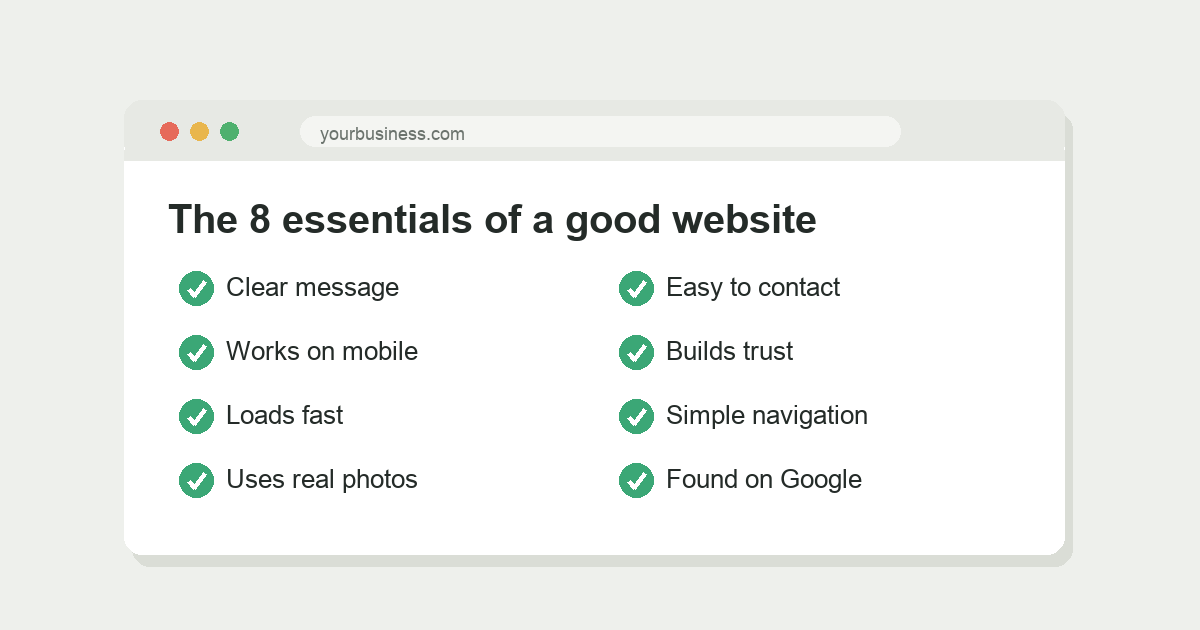
Here are the eight essentials that actually separate a website that works from one that just exists. Use it as a scorecard for your own site.
1. It says what you do in five seconds
A visitor should know who you are, what you offer, and who it’s for almost instantly — before they scroll. If someone lands on your homepage and has to hunt for what you actually sell, most will just leave. Clarity beats cleverness every time.
2. It works perfectly on a phone
In the Philippines, most people will see your site on their phone first. If it’s hard to read, tap, or navigate on mobile, it’s failing the majority of your visitors. A good website is built mobile-first, not squeezed down from a desktop afterthought.
3. It loads fast
Every extra second of loading time sheds visitors — and patience is thin on mobile data. Fast, well-built pages with properly sized images keep people around long enough to actually read what you offer. Speed is invisible when it’s right and brutal when it’s wrong.
4. It uses real photos
Genuine images of your work, products, space, or team build trust that stock photos simply can’t. They prove you’re real and make your brand look like itself, not like every other site using the same library. (More on this in our guide to real photos vs. stock photos.)
5. It’s easy to contact you — with a clear next step
Every page should make the next step obvious: call, message, book, or buy. Your phone number, a contact option, and a clear call-to-action should never be more than a tap away. A beautiful site that hides how to reach you is a missed sale.
6. It gives people reasons to trust you
Reviews, testimonials, a real “About” section, clear pricing or packages, and genuine contact details all quietly tell a visitor you’re legitimate and safe to deal with. Trust is what turns a browser into a buyer — especially for a business they’ve just discovered.
7. It’s simple to navigate
Most small businesses need only a handful of pages — home, about, services or products, and contact. A clean, obvious menu beats a sprawling one. If people can’t find what they’re looking for in a click or two, the design is working against you.
8. It can be found on Google
A good website is built so search engines can read it: sensible page titles, descriptions, fast clean code, and a structure Google understands. It won’t rank overnight, but the foundation has to be there — a gorgeous site nobody can find still isn’t doing its job.
Quick scorecard: how does your site measure up?
| Essential | Your site? |
|---|---|
| Clear message in 5 seconds | ✓ / ✗ |
| Works great on mobile | ✓ / ✗ |
| Loads fast | ✓ / ✗ |
| Uses real photos | ✓ / ✗ |
| Easy to contact + clear CTA | ✓ / ✗ |
| Trust signals (reviews, about) | ✓ / ✗ |
| Simple navigation | ✓ / ✗ |
| Findable on Google | ✓ / ✗ |
A few ✗’s aren’t a disaster — they’re a to-do list. For a fuller pre-launch run-through, our Cebu business website checklist covers the details.
The good news
None of these eight are exotic or expensive — they’re just the fundamentals, done properly. It’s exactly why we build on proven templates that already tick every box (mobile, fast, clean, SEO-ready) and tailor them to your brand, with real photography to match. You get a genuinely good website without paying custom-build prices. If you’d rather vet designers yourself first, our guide on how to choose a web designer helps.
The bottom line
A good small-business website is clear, fast, mobile-friendly, trustworthy, and easy to act on — with real photos and a solid SEO foundation. Nail those eight, and you have a site that actually earns its keep instead of just sitting there looking nice.
Frequently asked questions
What makes a website “good”?
A good website does its job: it clearly explains what you offer, works fast on mobile, builds trust with real photos and reviews, makes contacting you easy, and can be found on Google. Looking modern helps, but clarity and function matter far more than flashy design.
How many pages does a small business website need?
Most small businesses do well with just a few: a home page, an about page, a services or products page, and a contact page. It’s better to have a handful of clear, strong pages than many thin ones. You can always add more, like a blog, as you grow.
Does my website really need to be mobile-friendly?
Yes — in the Philippines, most visitors will view your site on a phone first, and Google also ranks based on the mobile version. A site that’s hard to use on mobile is failing the majority of its visitors, so mobile-friendly isn’t optional anymore.
Do I need professional photos for my website?
For anything that represents your business — your homepage, products, services, space, or team — real photos build far more trust than stock. You don’t need a huge shoot to start; a few strong images of what matters most make a big difference.
How do I know if my current website is any good?
Run it through the eight essentials: clear message, mobile-friendly, fast, real photos, easy contact and clear call-to-action, trust signals, simple navigation, and findable on Google. Any you can’t tick with confidence is a straightforward area to improve.
Want a website that ticks all eight boxes? Send us a note — no forms, no funnels — tell us about your business and we’ll help you build one that actually works.